- Just Released
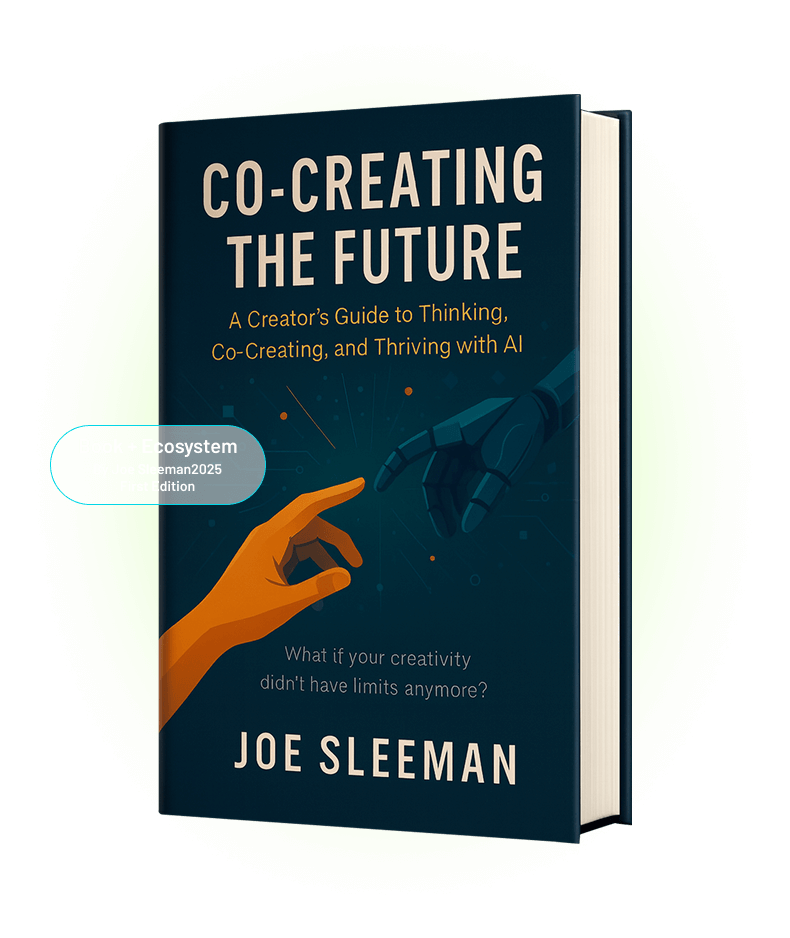
Co-Creating the Future
The Creator’s Toolkit for navigating the intersection of human creativity and artificial intelligence.
- Inside the Toolkit
About This Toolkit
This isn’t just a book—it’s a navigational instrument. Designed for modern creators, it bridges the gap between traditional artistry and the expansive possibilities of AI-enhanced workflows.
Clarity Map
Define intention + audience with precision.
Idea Expansion Loop
AI-enhanced brainstorming techniques.
Your Next Chapter
Practical steps to launch your vision.
- Chapter One
PREFACE — The Making of a Co-Creator
I’ve failed more times than I can count.
That’s not the line people expect from someone who builds technology for a living. But failure has been my co-founder far longer than success ever was. It’s sat beside me at 2 a.m. while code refused to compile, when clients backed out, when payroll was due and faith was the only remaining currency.
For years, I thought failure meant I’d done something wrong. Now I understand it meant I was still creating.
Beginnings
I grew up in northern Wisconsin, where winters were long, tools were scarce, and resourcefulness wasn’t optional. When something broke or we needed a tool, my dad didn’t reach for his wallet— he’d look at me and say, “You’re going to have to make it.”
At the time, I assumed he was just being cheap. But he was teaching me something far more valuable: how to be a problem solver. How to create what I needed instead of waiting for someone else to make it for me.
That lesson rooted itself deep.
So did something else: Abundance.
Growing up, I was taught to see life through a lens of possibility. We didn’t call it the Law of Attraction, but the idea was the same: your thoughts shape your reality, your energy shapes your outcomes, and you are always supported by something larger than you. You never lack what you need — only the awareness to recognize it.
Growing up, I was taught to see life through a lens of possibility. We didn’t call it the Law of Attraction, but the idea was the same: your thoughts shape your reality, your energy shapes your outcomes, and you are always supported by something larger than you. You never lack what you need — only the awareness to recognize it.
I didn’t have the language for it then, but that belief shaped everything. It taught me that possibility was always within reach, even if the world around me didn’t match it yet.
Before I graduated high school, I started my first company—a professional photography studio. I discovered I had an eye for composition, light, and emotion. Weddings, portraits, commercial shoots—I loved capturing the invisible threads that make a moment matter. It was my first taste of creativity meeting commerce, and of independence meeting identity.
Those early years taught me that creation wasn’t about having tools.
It was about becoming one.
The Burnout Years
There were seasons when I measured my worth by motion. More clients, more launches, more features, more hours. I thought growth meant acceleration, but it was really a slow bleed. I was working harder, not deeper.
I remember staring at a wall of dashboards—traffic spikes, revenue charts, conversion funnels—and feeling absolutely nothing. I’d built powerful tools, but somewhere along the way I’d lost the creative joy that made me want to build in the first place.
That’s when I learned that technology without purpose is just noise.
Rebuilding
I started designing differently. Not for markets—for people.
For scientists, creators, entrepreneurs.
For anyone trying to turn chaos into clarity.
Some of those projects succeeded. Others didn’t. But every attempt revealed a truth I couldn’t ignore:
Creation had outgrown the capacity of any one person.
The world was moving too fast.
The data was too dense.
The expectations were too high.
No one—no matter how experienced—could keep up alone.
The Moment Everything Shifted
The first time I used AI in a real workflow, I felt the same spark I had as a kid in that freezing garage, fashioning a tool out of scraps because we couldn’t buy the one we needed.
It wasn’t about automation.
It was amplification.
Suddenly, the impossible felt possible again.
AI became my quiet collaborator.
It helped me think faster, test ideas quicker, and see patterns I’d been too close to notice. It didn’t replace my imagination—it expanded it.
It reminded me what creation feels like when limitation isn’t part of the equation.
I began building differently—not as a lone architect, but as a co-creator with intelligence itself.
Lessons in the Mess
Failure taught me everything I needed to know about creation long before AI arrived:
Iteration is sacred. Every mistake is information.
Discomfort is feedback. Growth hides inside what feels uncertain.
Faith is a technology. Every invention begins with believing in something you can’t yet see.
So when I talk about co-creating the future, I’m not just talking about algorithms and neural networks. I’m talking about you and me—the humans behind the keyboards—learning to work with something that reflects our best and worst instincts back to us.
If failure was my first teacher, AI may be the next one.
Why I’m Writing This Book
I’ve spent decades building software that helps people organize chaos—marine scientists tracking wildlife, agencies supporting clients, creators turning ideas into income. Through it all, one truth has held steady:
We build tools to become more human, not less.
This book is about that intersection—the place where creativity meets intelligence and something new emerges. It’s about what I’ve learned from falling down, getting up, and learning how to build with something instead of building against the limits of time, energy, or capacity.
If you’ve ever felt burned out, uncertain, or left behind by the speed of change, I’ve been there. I wrote this book to tell you:
The future isn’t happening to you—it’s happening with you.
Failure got me here.
Curiosity keeps me here.
And what comes next— that’s what we’re about to co-create together.
The future isn’t happening to you—it’s happening with you.
“We build the tools that build us.” — Marshall McLuhan
The first time I watched artificial intelligence finish something I had only started, it felt strangely familiar. The cursor blinked, a sentence unfolded, and suddenly a concept that had lived half-formed in my mind appeared on the screen—clear, confident, complete. I didn’t feel threatened. I felt seen.
It reminded me of a place far from glowing monitors and machine learning models—a cold Wisconsin garage where my father kept his tools hanging in perfect rows above an oil-stained workbench. The air always smelled of pine, metal, and gasoline. When something broke, he never said, “We’ll buy a new one.” He’d wipe his hands on a rag and tell me the same thing every time: “You’re going to have to make it.”
At fifteen, that sounded like punishment disguised as thrift. But standing there in that garage—snow drifting against a small window, the furnace rumbling, a project half-built on the bench—I unknowingly absorbed the lesson that would define my life: creation begins where resources end. That’s where imagination takes over. That’s where you learn to make something from nothing.
Those nights didn’t just teach me to fix things. They taught me how reality works. I was raised with the idea that abundance isn’t a reward — it’s the natural state you tap into when you shift your perspective. You weren’t lacking anything; you were learning to notice what was already there. In that garage, abundance meant rejecting limitation. It meant trusting that answers were available, even before you knew where to find them. It meant treating the world as something that responds to your mindset, not just your actions.
By the time I graduated high school, that early training in resourcefulness had taken on a new form. I saved enough money to buy a used Nikon F—scratched, dented, perfectly imperfect—and opened a small photography studio above a donut shop in Superior, Wisconsin. My first wedding assignment left me terrified. I stood in the back of the church whispering, “Don’t miss the kiss.” Thankfully, I didn’t. When the couple saw the print, they cried. That moment taught me that creativity wasn’t about equipment—it was about empathy. You had to feel something before you could capture it.
For years, that little studio became my entire world. Weekends filled with weddings, weekdays with portraits, late nights in a darkroom where images slowly bloomed under red light. Watching a blank sheet turn into a living moment felt like magic—the same magic I had felt shaping makeshift tools in my father’s garage. Different medium. Same miracle.
When digital photography arrived, I resisted. It felt too fast, too clean, like convenience pretending to be art. But curiosity eventually won, as it always does. The instant I saw a digital image appear on a screen, I understood: immediacy doesn’t kill creativity; it accelerates learning. The tools change. The mission doesn’t.
As the years rolled on, I built bigger things—websites, applications, platforms. Each success gave me permission to chase a larger vision. But somewhere along the way, I lost the quiet joy that fueled me. I became addicted to movement. More launches, more clients, more dashboards, more proof that I was “winning.” My days blurred into output. Creation became something I performed instead of something I lived.
One winter night—because my lessons always seem to arrive in winter—I stared at five glowing monitors filled with analytics. Charts pulsed with traffic and revenue, but inside I felt nothing. No spark. No satisfaction. Just the weight of constant making. That’s when I realized I’d been measuring creativity in the wrong currency. I was chasing outcomes, not alignment.
The spiritual ideas I had grown up with drifted back to me—quietly at first, then insistently. What you create externally mirrors what you hold internally. The Law of Attraction wasn’t some mystical concept; it was simply the physics of intention. Every project I’d ever loved had begun not from pressure, but from presence. From belief. From the excitement of possibility.
So I shut everything down. The screens. The dashboards. The noise. I asked myself the question that used to come so naturally in my dad’s garage: What do I actually want to make? The answer didn’t appear immediately, but the moment I stopped forcing motion, momentum found me. Ideas surfaced. Opportunities appeared. Conversations aligned out of nowhere. It was as if the universe had been waiting for me to stop sprinting long enough to receive.
It was during that period—right as I began listening again—that AI entered my world in a meaningful way. At first, it was just convenience: autocorrect that finally understood context, editing tools that cleaned backgrounds, voice assistants that could schedule meetings. Then one evening, I typed a half-formed idea into a generative program. Seconds later, paragraphs appeared—organized, articulate, eerily aligned with my intention.
It felt like standing in a darkroom again, watching an image emerge from nothing. Only this time, the image was thought made visible. I remember laughing. “So this is what collaboration feels like when the other mind is made of code.”
It didn’t feel like outsourcing. It felt like remembering—like returning to a way of creating that was more intuitive than intellectual. Every prompt became a dialogue. I’d refine; it would respond. Together we shaped ideas faster than I ever could alone. The AI wasn’t thinking—not the way humans think. But it amplified my imagination. It pushed me past hesitation and mirrored my momentum.
The clearer I became about what I wanted, the better the system responded. My prompts became almost spiritual—specific, intentional, emotional. I realized that creation had always been a partnership between idea and execution, intention and energy. The Law of Attraction calls it alignment. AI simply made alignment visible. When I became clear, it became powerful.
That’s when I understood something profound: the lesson my father taught me in that cold garage—“make what you need”—was the same lesson AI was teaching now. Nothing arrives until you engage with it. Not tools. Not ideas. Not possibilities.
And suddenly, I could see my whole life differently. Those nights building in the garage, those long darkroom hours, the early startups, the seasons of burnout—they were all preparing me for this new moment where creativity itself would become infinite. Across the world, people were experiencing the same thing: designers refining prototypes, educators creating adaptive lessons, filmmakers storyboarding entire scenes, creators turning imagination into output in seconds.
Different cities. Different tools. Same realization. Human plus AI doesn’t diminish creativity. It accelerates it.
The world isn’t just changing.
The way we create is changing.
And what comes next—well, that’s what we’re here to explore.
Author’s Reflection — Chapter 1: The Co-Creator Era
What surprised me most about writing this chapter wasn’t the technology. It was the recognition.
The moment AI completed a thought I had only half shaped, I wasn’t amazed by the software. I was amazed by the reminder that intelligence was never meant to be solitary. The world had trained me to believe I had to create alone — to hold everything, solve everything, imagine everything by myself.
But the truth is, creation has always been collaborative.
With our intuition.
With our energy.
With the subtle guidance that comes when we finally get quiet enough to hear it.
AI didn’t invent collaboration.
It simply made it visible.
If Chapter 1 leaves you with anything, I hope it’s this:
You don’t lose your creativity when you collaborate with AI.
You meet more of it.
AI doesn’t replace imagination.
It expands it.
It frees it.
It hands you back the part of yourself you buried under pressure, deadlines, and the belief that you had to do all the heavy lifting alone.
This chapter reminded me of something my father taught me without ever saying it outright: you’re never creating by yourself — not really.
When you bring clarity, intention, and presence to what you’re making, the universe has a way of meeting you halfway.
AI is simply one more way it does.